Apostolic Journey to Spain
6–12 Jun 20267days
4cities
5,200km
1countries
Follow the route
The journey · Spain
N
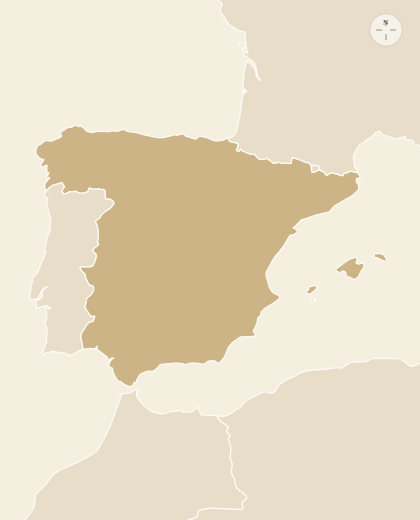
SPAIN
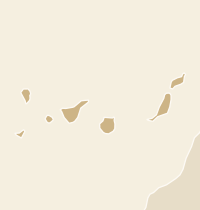
Canary Is.
Tap a city to explore
i.MadridSat 6 Jun – Tue 9 Jun
🇪🇸
Madrid
40.42° N, 3.70° W · stop 1 of 4 · Sat 6 Jun – Tue 9 Jun
Madrid is the administrative and ecclesiastical heart of Spain. As the seat of the Archdiocese of Madrid and home to the Almudena Cathedral, it has historically been a stronghold of Spanish Catholicism and a center for lay movements. It holds modern significance for having hosted millions of young Catholics during World Youth Day in 2011.
Schedule
Saturday6 Jun
6 Jun · 10:30
Arrival in Madrid
Pope Leo XIV landed at Barajas Airport, beginning his six-day apostolic journey to Spain.
Adolfo Suárez Madrid/Barajas International Airport
6 Jun · 11:30
Welcome Ceremony and Courtesy Visit to the King and Queen
An official welcome ceremony was held at the Royal Palace. The Pope then paid a courtesy visit to Their Majesties the King and Queen of Spain.
Royal Palace of Madrid
6 Jun · 12:30
Meeting with Authorities, Civil Society and Diplomatic Corps
Pope Leo XIV addressed Spanish political authorities, civil society representatives, and the diplomatic corps at the Royal Palace.
Royal Palace of Madrid
6 Jun · 18:00
Visit to the CEDIA 24 Horas Social Project
The Pope visited staff and beneficiaries of the CEDIA 24 Horas project, which provides round-the-clock emergency social assistance to the most vulnerable residents of Madrid.
CEDIA 24 Horas, Madrid
6 Jun · 20:30
Prayer Vigil with Young People
Thousands of young people gathered with Pope Leo XIV at Plaza de Lima for a nocturnal prayer vigil.
Plaza de Lima, Madrid
Sunday7 Jun
7 Jun · 10:00
Holy Mass with Corpus Christi Procession
Pope Leo XIV celebrated Holy Mass at Plaza de Cibeles, followed by the Corpus Christi Procession through the streets of Madrid.
Plaza de Cibeles, Madrid
7 Jun · 18:00
Meeting with Culture, Art, Economy and Sport
The Pope met with representatives of Spanish cultural, artistic, economic, and sporting life at the Movistar Arena.
Movistar Arena, Madrid
Monday8 Jun
8 Jun · 09:30
Meeting with the Prime Minister
Pope Leo XIV met privately with Spanish Prime Minister Pedro Sánchez at the official government residence.
Palacio de la Moncloa, Madrid
8 Jun · 10:30
Meeting with Members of the Spanish Parliament
The Pope addressed members of both chambers of the Spanish Parliament at the Congress of Deputies.
Congress of Deputies, Madrid
8 Jun · 11:30
Meeting with the Bishops of Spain
Pope Leo XIV met with the bishops of Spain at the headquarters of the Spanish Bishops' Conference.
Episcopal Conference, Madrid
8 Jun · 18:00
Prayer before Our Lady of Almudena
The Pope prayed before the image of Our Lady of Almudena, patroness of Madrid, at the Cathedral of La Almudena.
Cathedral of La Almudena, Madrid
8 Jun · 19:00
Meeting with the Diocesan Community
Pope Leo XIV met with priests, religious, and lay faithful of the Diocese of Madrid at the Santiago Bernabéu Stadium.
Santiago Bernabéu Stadium, Madrid
Tuesday9 Jun
9 Jun · 10:20
Meeting with Volunteers
Before flying to Barcelona, the Pope met with volunteers and charitable workers at the IFEMA exhibition center.
IFEMA Madrid
The journey so far
ii.BarcelonaTue 9 Jun – Thu 11 Jun
🇪🇸
Barcelona
41.39° N, 2.17° E · stop 2 of 4 · Tue 9 Jun – Thu 11 Jun
Barcelona is a city where faith and groundbreaking architecture intersect. It is globally recognized for the Basílica de la Sagrada Família, Antoni Gaudí's monumental "Bible in stone," which translates complex Catholic theology into physical structure. The city also has deep roots in Christian antiquity, dating back to early martyrs like Saint Eulalia.
Schedule
Tuesday9 Jun
9 Jun · 12:25
Arrival in Barcelona
Pope Leo XIV flew from Madrid to Barcelona and arrived at El Prat Airport, continuing the apostolic journey.
Josep Tarradellas Barcelona/El Prat International Airport
9 Jun · 13:00
Midday Prayer
The Pope prayed the midday prayer in Barcelona's Gothic cathedral, dedicated to the city's patron saint, Saint Eulalia.
Cathedral of the Holy Cross and Saint Eulalia
9 Jun · 20:00
Prayer Vigil
Thousands of young people joined Pope Leo XIV for the prayer vigil at the Olympic Stadium on Montjuïc.
Lluís Companys Olympic Stadium
Wednesday10 Jun
10 Jun · 10:50
Visit to Brians 1 Penitentiary Center
The Pope visited inmates and staff at the Brians 1 prison near Barcelona, emphasizing the values of mercy and rehabilitation.
Brians 1 Prison, Sant Esteve Sesrovires
10 Jun · 12:00
Recitation of the Holy Rosary
Pope Leo XIV prayed the Rosary with the Benedictine community at the Abbey of Montserrat, the spiritual heart of Catalonia.
Abbey of Our Lady of Montserrat
10 Jun · 16:30
Meeting with Diocesan Charitable Organizations
The Pope met with representatives of Caritas and other diocesan charitable organizations serving the poor and marginalized.
Barcelona
10 Jun · 19:30
Holy Mass — Inauguration of the Tower of Jesus Christ
Pope Leo XIV celebrated Holy Mass at the Sagrada Família and inaugurated the Tower of Jesus Christ, completing Antoni Gaudí's visionary masterpiece.
Basilica of the Sagrada Família, Barcelona
The journey so far
iii.TenerifeFri 12 Jun
🇪🇸
Tenerife
28.29° N, 16.63° W · stop 4 of 4 · Fri 12 Jun
Largest of the Canary Islands and a front-line point of arrival for migrants crossing from West Africa. The Canary Islands received over 46,000 migrants by sea in 2023 alone. The Pope's presence here is a pastoral gesture of solidarity with those who risk their lives on the Atlantic passage, and with the Church workers who receive them.
Schedule
Friday09:10
Arrival in Tenerife
Pope Leo XIV arrived at Tenerife Norte Airport on the final day of the apostolic journey to Spain.
Tenerife Norte/Los Rodeos International Airport
09:30
Meeting with Migrants
The Pope met with migrants housed at the Las Raíces reception center in La Laguna, listening to their testimonies and offering words of comfort.
Las Raíces Center, La Laguna
10:10
Meeting with Migrant Integration Organizations
Pope Leo XIV met with associations and volunteers working on the integration of migrants in Tenerife society.
Plaza del Cristo de La Laguna
12:15
Holy Mass
Pope Leo XIV celebrated the concluding Holy Mass of his journey to Spain at the Port of Santa Cruz de Tenerife.
Port of Santa Cruz de Tenerife
The journey so far
iv.Gran CanariaThu 11 Jun – Fri 12 Jun
🇪🇸
Gran Canaria
27.92° N, 15.55° W · stop 3 of 4 · Thu 11 Jun – Fri 12 Jun
The "continent in miniature", Gran Canaria is home to the Diocese of Canarias — one of Spain's oldest sees, established in 1406 — and to a Caritas network that leads humanitarian response on the islands. Las Palmas de Gran Canaria hosts the Cathedral of Santa Ana, built in the 15th century, the spiritual anchor of the Canarian Church.
Schedule
Thursday10:50
Arrival in Gran Canaria
Pope Leo XIV arrived at Gando Air Base on the island of Gran Canaria, continuing the apostolic journey.
Gando Air Base, Gran Canaria
11:40
Meeting with Organizations Supporting Migrants
The Pope met with migrants and humanitarian organizations assisting them at the port of Arguineguín, one of the main arrival points for migrants from West Africa.
Port of Arguineguín
13:30
Meeting with Bishops, Clergy and Pastoral Workers
Pope Leo XIV met with the bishops, priests, deacons, and lay faithful of the Diocese of Las Palmas at the Cathedral of Saint Anne.
Cathedral of Saint Anne, Las Palmas
18:30
Holy Mass
Pope Leo XIV celebrated Holy Mass at the Gran Canaria Stadium before a large gathering of faithful from the Canary Islands.
Gran Canaria Stadium
The journey so far
i.
The journey so far
MadridSat 6 JunVisited
BarcelonaTue 9 JunVisited
Gran CanariaThu 11 JunVisited
TenerifeFri 12 JunVisited
“
Do not be afraid. Open wide the doors to Christ.Saint John Paul II · First Homily, 22 October 1978
Following the trail to Barcelona?
Experiences in Barcelona
Hand-picked tours and skip-the-line entries, a short walk from where the Pope will be.