Sister Petrini on Moral Decisions Guiding Future of Work
During a keynote address at the high-level event titled 'AI and the Future of Work' in Rome, Sister Raffaella Petrini, President of the Governorate of Vatican City State, emphasized that the future of work depends not o…
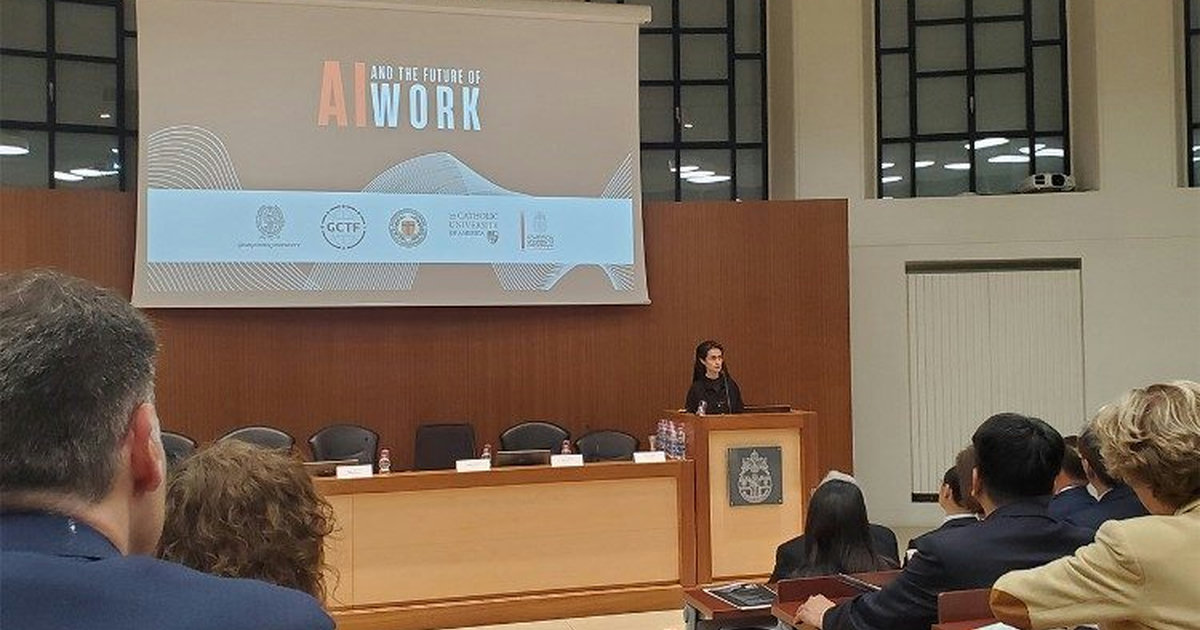
During a keynote address at the high-level event titled 'AI and the Future of Work' in Rome, Sister Raffaella Petrini, President of the Governorate of Vatican City State, emphasized that the future of work depends not on machines, but on humanity's moral choices.
This significant discussion took place on Tuesday morning at Rome's Pontifical Gregorian University, convened by the U.S. Embassy to the Holy See and co-sponsored by ambassadors from Australia, Britain, Canada, Japan, Taiwan, and the United States. The event gathered a diverse group of experts, including technology creators, theologians, ethicists, policymakers, and academics, to explore the impact of artificial intelligence (AI) on the workforce.
Sister Petrini stated, "In today's era of profound innovation, AI offers enormous potential, but also brings us to a crucial crossroads." She highlighted that significant choices must be made to ensure that technology aligns with human and social values, particularly given that work is deemed essential for fulfilling human potential. She described work as a means through which individuals express their humanity in an increasingly automated environment.
As she elaborated on the transformative nature of AI, Sister Petrini posed critical questions about human identity in a world dominated by automation, noting that AI's influence reshapes the labor market, offering both opportunities and exclusion. She referenced a report from the International Labour Organization, which indicated that digitalization could improve workplace conditions but also raised concerns about emerging risks like excessive surveillance and job displacement.
According to her, it is crucial that technology serves humanity rather than replaces it. She said, "Artificial intelligence can be a very useful way of learning, a way of perceiving, if guided by a vision or a tool." This underscores her call for a balanced relationship between humans and technology, reliant on responsibility, cooperation, and education.
Sister Petrini cautioned against an unquestioning acceptance of AI, insisting, "We must not fear AI, but not simply accept it blindly." She advocated for ongoing international cooperation that promotes a vision of economic progress grounded in human values, emphasizing that the trajectory of AI development reflects the values of those who create it.


